

By Power Hedge
The past two months have certainly been eventful ones for the oil market. For the first time in history, the Strait of Hormuz was closed to maritime traffic, which has caused a massive shortage of crude oil globally. After all, approximately 20.3 million barrels of crude oil move through the Strait every single day. That is roughly 20% of total global oil consumption, at least calculated using the most recent figures (which are from 2024). The closure of the Strait has prevented this oil from reaching the global market, and it has ultimately resulted in a supply shortage. This has naturally caused the price of crude oil to rise. Another major event that recently affected the oil market is that the United Arab Emirates announced that it will leave the Organization of Petroleum Exporting Countries on May 1, 2026, which could weaken the ability of that international organization to control the price of crude oil. In this article, we will look at the ramifications of this decision and how it could affect oil prices going forward.
The UAE’s History And Position Within OPEC
The United Arab Emirates first joined the Organization of Petroleum Exporting Countries in 1967, which was before the UAE as we know it today even existed. Originally, it was Abu Dhabi that joined OPEC in 1967, and then the United Arab Emirates became a member when Abu Dhabi joined with six other emirates to become the nation that we know today as the United Arab Emirates. The seven emirates that make up the nation are:
- Abu Dhabi
- Dubai
- Sharjah
- Ajman
- Umm Al Quwain
- Ras Al Khaimah
- Fujairah
Abu Dhabi is the largest of the seven emirates, as well as being the capital of the federation. Abu Dhabi is also the emirate that produces the most oil in the United Arab Emirates, as it contains fully 96% of the country’s 100 billion barrels of proven oil reserves. According to the International Trade Association, the United Arab Emirates produces about 3.2 million barrels of crude oil per day, most of which is produced in Abu Dhabi. The Associated Press claims that the United Arab Emirates produces about 3.4 million barrels of crude oil per day, but the two figures are close enough to one another that it could be a matter of how certain figures are rounded. In either case, all twelve member nations of the Organization of Petroleum Exporting Countries had a combined production of 30.93 million barrels of crude oil per day in December 2025, a figure that has remained relatively stable for a number of years now:
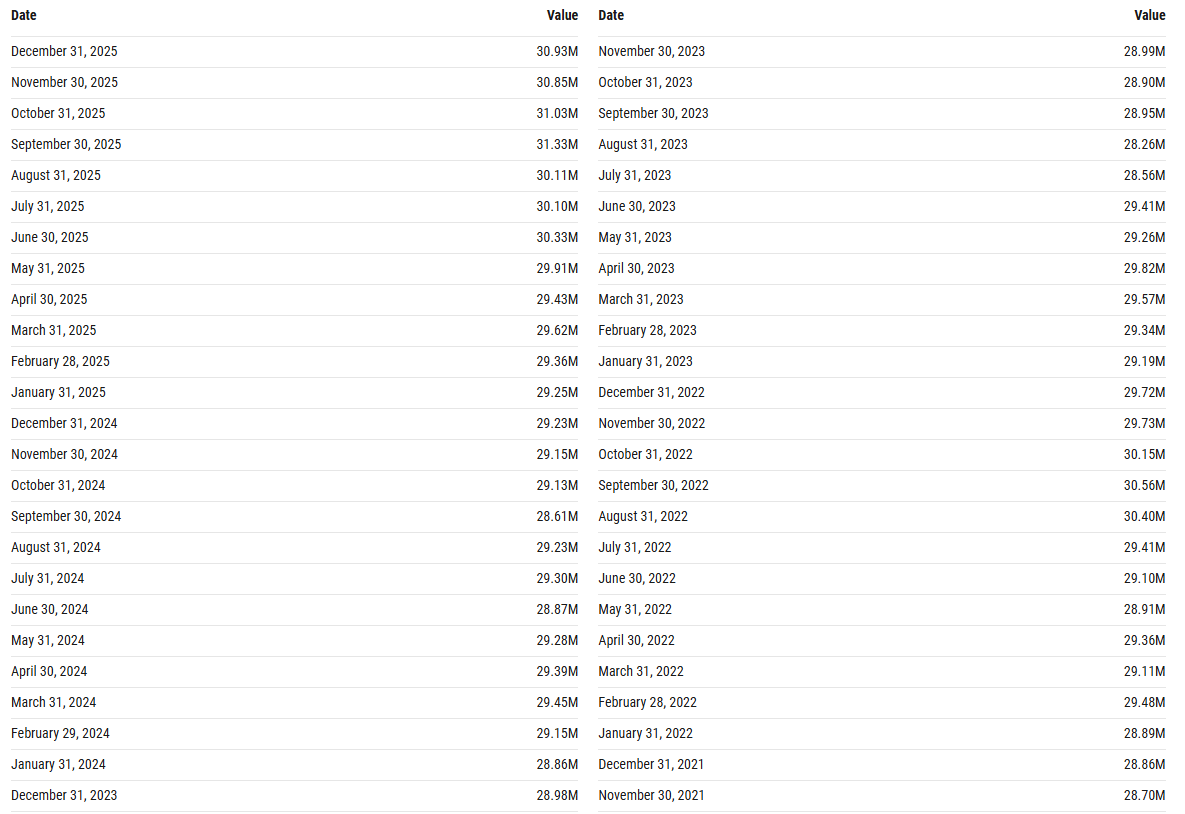
This chart shows the average daily production of all twelve OPEC members combined going back to 2021. As we can see, the figures were relatively range-bound between about 28.5 million and 31 million barrels of crude oil per day over the entire period. Thus, the United Arab Emirates is responsible for about 10.67% of the production of the twelve-nation bloc. This would be the amount of production that OPEC would lose once the United Arab Emirates leaves on May 1, 2026. However, the world will not lose this much production. The United Arab Emirates still intends to be an oil producer and an oil-exporting country; it just will no longer be a member of the Organization.
According to the Energy Institute’s Statistical Review of World Energy, the worldwide consumption of oil was 101.8 million barrels per day in 2024. Unfortunately, 2025 figures have not been published yet (they usually come out around the middle of the following year, so we can expect the Energy Institute to release its figures for 2025 in July). Thus, the Organization of Petroleum Exporting Countries supplies about 30% of all oil consumed worldwide. Without the United Arab Emirates, it will only account for 27% of worldwide oil supplies, so this is arguably not a huge decline. The organization will still account for a fairly significant proportion of worldwide oil supplies. It also controls a lot more than 30% of worldwide oil reserves. This chart shows the top fourteen countries in terms of proven oil reserves:
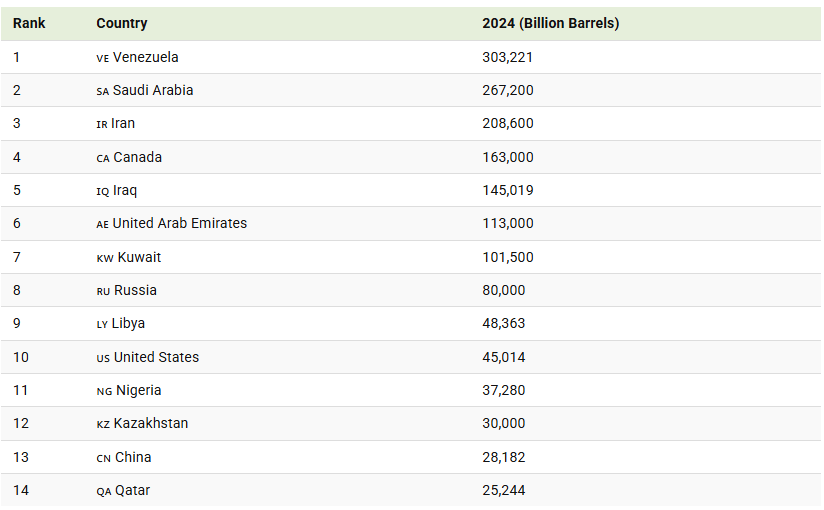
(This chart follows the European standard of using a comma instead of a decimal point. For example, Venezuela has proven reserves of roughly 303 billion barrels of oil, not 303 trillion barrels.)
The twelve member countries of the Organization of Petroleum Exporting Countries are Algeria, the Republic of the Congo (not to be confused with the Democratic Republic of the Congo, which is not an OPEC member), Equatorial Guinea, Gabon, Iran, Iraq, Kuwait, Libya, Nigeria, Saudi Arabia, the UAE, and Venezuela. These twelve nations have total proven oil reserves of 1.241294 trillion barrels of crude oil. That is approximately 70.32% of all proven oil reserves worldwide. The departure of the UAE from OPEC would reduce the organization’s proven reserves down to 1.128294 trillion barrels, or about 63.9% of the worldwide total oil reserves. Thus, even without the United Arab Emirates as a member, the Organization of Petroleum Exporting Countries will still control a significant fraction of all the oil in the world.
Venezuela And Iran
One thing that could be important to mention here is that Venezuela and Iran control a sizable proportion of OPEC’s remaining reserves following the departure of the United Arab Emirates. The two of them together control 511.821 billion barrels of proven reserves, which is roughly 45.4% of the total combined reserves of all OPEC members minus the United Arab Emirates.
The reason that I bring this up is that, back in January, the United States conducted a special military operation in which it captured Venezuelan President Nicolas Maduro. The United States said that it will be taking control of Venezuela’s oil reserves, and it will be encouraging American oil companies to invest in developing them to a productive state. It is uncertain whether or not any American oil companies will be interested in this very expensive project. Chevron (CVX) is the only American oil company currently active in Venezuela right now. BlackRidge research predicts that Exxon Mobil (XOM) and ConocoPhillips (COP) might be interested in developing the countries’ massive oil reserves, but I will admit that I have my doubts. Exxon Mobil and ConocoPhillips both suffered losses in the country before due to past nationalizations of oil resources, and ConocoPhillips was even awarded $10 billion by an international arbitration court. Venezuela has yet to pay out on those claims. Due to these past losses, I suspect that both companies will be very cautious about wanting to return to Venezuela.
The United States is not a member of OPEC. This poses the question of whether or not Venezuela will itself remain an OPEC member should the United States have control over its oil reserves. If the country’s new government were to choose to leave, then this would certainly reduce the proportion of the world’s oil reserves that are under the control of a member nation of the Organization of Petroleum Exporting Countries.
We have a similar situation in Iran. Officially, the United States and Israel want to prevent Iran from obtaining nuclear weapons. It is unclear whether or not there are other objectives, as some U.S. media are claiming that President Trump wants to change the leadership of Iran. However, the Trump Administration has also stated that it is not after a regime change. Regardless of the actual motives behind the war, several members of Iran’s leadership have been killed in the conflict, so a new leader will need to take power at some point. It is possible that the new leadership will want to develop Iran’s oil reserves and industry without worrying about things such as production quotas that are imposed by OPEC.
It is important to keep in mind that, as of right now, the only country that has announced that it is leaving the Organization of Petroleum Exporting Countries is the United Arab Emirates. We can say with certainty that two of the three most oil-rich countries in the organization will be coming under new leadership, and that could have an impact that is greater than the UAE’s departure. However, for right now, this is all speculation.
The Rationale For The United Arab Emirates Leaving OPEC
The Organization of Petroleum Exporting Countries offers the following mission statement on its website:
In accordance with its Statute, the mission of the Organization of the Petroleum Exporting Countries is to coordinate and unify the petroleum policies of its Member Countries and ensure the stabilization of oil markets in order to secure an efficient, economic and regular supply of petroleum to consumers, a steady income to producers and a fair return on capital for those investing in the petroleum industry.
In practice, the Organization of Petroleum Exporting Countries uses production quotas in order to attempt to control the supply of crude oil in the markets in an attempt to control the price.
The United Arab Emirates appears to want to develop its oil industry to support its own development goals rather than coordinating with other nations to achieve group goals. The official statement from the UAE stated that “this decision reflects the UAE’s long-term strategic and economic vision and evolving energy profile,” and it added, “During our time in the organization, we made significant contributions and even greater sacrifices for the benefit of all.” This suggests to me that the leadership of the United Arab Emirates thinks that the country has been sacrificing its own development and goals in order to serve the interests of OPEC.
As is the case with many oil-exporting nations, the United Arab Emirates has a state-owned oil company that develops and manages the oil fields located within the country’s territory. The name of this company is the Abu Dhabi National Oil Company. This company has been investing in numerous energy projects in the past few years, and during U.S. President Trump’s visit to Abu Dhabi in May 2025, the company announced more than $60 billion worth of new energy projects. These include some joint ventures and partnerships with American energy companies:
- Increasing the oil production of the Upper Zakum offshore field in Abu Dhabi—partnership with Exxon Mobil
- Exploring a possible expansion of the production capacity at the Shah sour gas field—partnership with Occidental Petroleum (OXY)
- Exploring Unconventional Onshore Block 3 in Abu Dhabi with the hopes of discovering resources—partnership with EOG Resources (EOG)
The Abu Dhabi National Oil Company says that it expects to have a maximum production capacity of five million barrels of crude oil per day by 2027. That would represent a 56% increase over the 3.2 million barrels of crude oil per day that the United Arab Emirates produces on average right now.
The United Arab Emirates is actively trying to diversify its economy away from crude oil. More precisely, it wants to reduce the proportion of its gross domestic product that comes from crude oil by growing other industry sectors. The country appears to want to use its oil resources as a way to get money that can then be invested into other sectors of the economy. This would explain the investments in oil and gas, as the country wants to grow its production of these resources to obtain additional capital for its diversification plan. It appears that its leadership believes that continued adherence to OPEC’s production quotas will get in the way of its own goals.
Putting It All Together
The United Arab Emirates announced its decision to leave the Organization of Petroleum Exporting Countries on April 28, 2026. That announcement, by itself, does not appear to have had any impact on the price of crude oil. This chart shows the spot price of Brent crude oil over the past month:
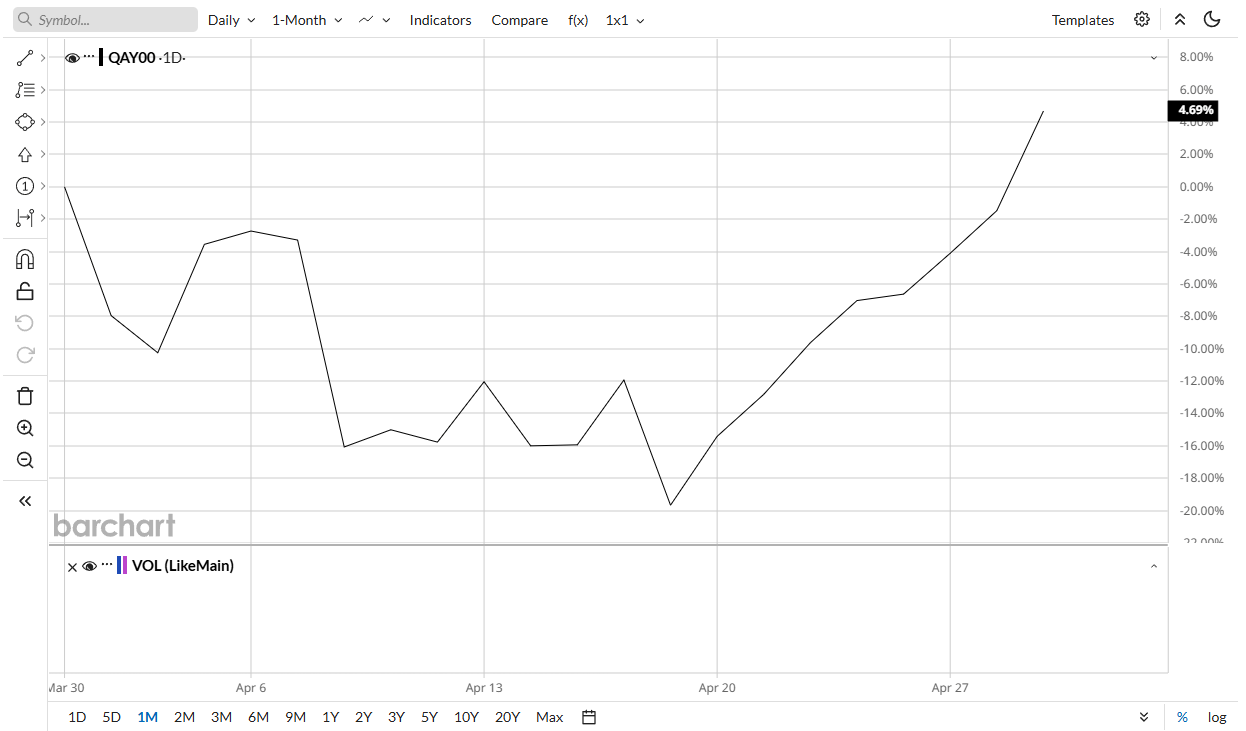
As this chart shows, Brent crude oil has risen on almost every day since April 17. Thus, it is unlikely that the announcement from the United Arab Emirates has any effect at this time. This makes sense because Abu Dhabi is on the Persian Gulf:
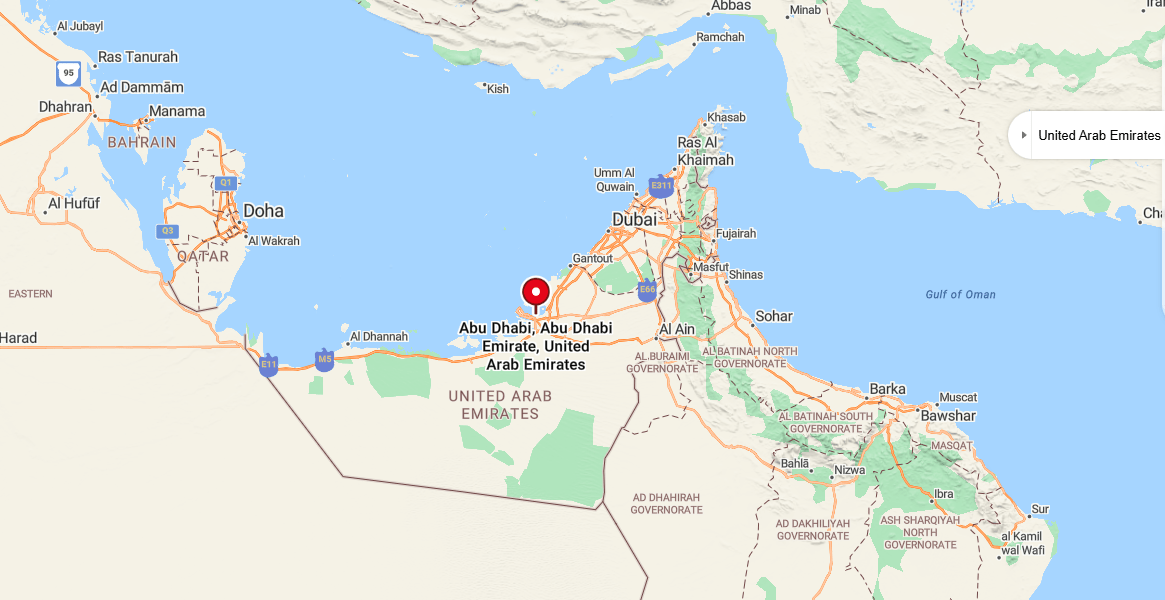
The Strait of Hormuz is the section of water between Khasab and Abbas. On the west side of the Strait is the Persian Gulf, and on the east side of the Strait is the Gulf of Oman. As Abu Dhabi is the location of nearly all of the country’s oil reserves and oil production, the closure of the Strait of Hormuz has prevented oil from traveling from Abu Dhabi to the rest of the world. The UAE does actually border the Gulf of Oman, and if it could get its oil to Fujairah, which is a major port city on the Gulf of Oman, then the country could bypass the Strait of Hormuz and export oil from there. The UAE does have a transportation route that could do this, which is the Abu Dhabi Crude Oil Pipeline. This is a pipeline that runs from Habshan to Fujairah, where oil tankers can pick up the oil and take it to the rest of the world. This is one of the two routes that nations situated along the Persian Gulf can use to bypass the Strait of Hormuz (the other is a pipeline in Saudi Arabia that runs to a port city along the Red Sea). However, the Abu Dhabi Crude Oil Pipeline can only carry 1.5 million to 1.8 million barrels per day, which is obviously less than the 3.2 million barrels per day that the United Arab Emirates produces. As such, the nation can only get at best half of its production to the market until the Strait of Hormuz is reopened.
This is the biggest reason why the market seems to have shrugged off the announcement about the UAE leaving OPEC. There is not sufficient transportation capacity in place to allow all of the oil produced in the Persian Gulf countries to bypass the Strait of Hormuz. Until the Strait is reopened, the global market will have an insufficient supply available to satisfy the demand for oil. Thus, there will be a supply shortage. In the short term, the situation surrounding the Strait of Hormuz will be the thing that dictates oil price movements.
However, in the longer term, the UAE’s departure from the Organization of Petroleum Exporting Countries could have an impact on the oil market. As was already mentioned, the UAE is responsible for about 10% of OPEC’s total production. The loss of that production would obviously reduce OPEC’s global market share. More important, though, is the fact that the United Arab Emirates wants to increase its production. If it manages to achieve the five-million-barrel-per-day target, that would result in an additional 1.8 million barrels of crude oil of supply on the market. The remaining OPEC nations might be willing to reduce their production by that much, and in fact, that was smaller than the 3.66 million barrels per day that the Organization cut from production in 2023. There is no guarantee that they would be willing to do so, however, and they would almost certainly not want to make such sizable cuts permanent, as it would negatively impact their own economies. As such, it is very possible that once the Strait of Hormuz reopens and the oil market gets back to its previous status quo (which will take several months after the Strait is reopened), oil prices will be lower than the state of affairs prior to this event.
Conclusion
In conclusion, the departure of the United Arab Emirates from the Organization of Petroleum Exporting Countries could weaken the Organization’s ability to influence worldwide oil prices. However, the eleven remaining member nations of OPEC still control the majority of the world’s proven oil reserves, so while OPEC’s ability to influence prices might be weakened, investors would be wise to continue to pay attention to it. This conclusion could change, however, as both Venezuela and Iran will end up under new leadership (whoever that may be), and it is possible that their new leadership will have an agenda separate from OPEC. For the time being, the shortage of crude oil caused by the closure of the Strait of Hormuz will continue to dominate oil pricing and trading. After that is finally resolved, though, the UAE’s independent efforts to increase its production could result in the world having a greater supply of oil than in the past, and this could result in lower oil prices.